
“Don’t assume you can’t become a business owner. There are often multiple funding strategies available. You just need to understand your options.” — Michele Simones, Guidant Financial
Many aspiring entrepreneurs have the experience, relationships, and drive to build a successful business. What often holds them back is one question: How will I fund it?
During our latest iBoost Talent Bonfire Q&A, we joined Michele Simones of Guidant Financial and Bill Tasillo of iBoost Talent to explore alternative funding strategies, including how qualified retirement savings may help turn business ownership into a reality.
Here are the biggest takeaways from the conversation. Feel free to watch the 30-minute Q&A replay, hosted by Becca Lynn, VP of marketing.
1. Your retirement savings may be a source of startup capital
A Rollover for Business Startups, commonly called ROBS, allows qualified individuals to invest eligible retirement funds into a new business without treating the transaction as an early withdrawal.
Eligible funds may include money from a previous employer’s 401(k), 403(b), TSP, or certain IRAs. When properly structured, the transaction does not create an early-withdrawal penalty or immediate income-tax liability. You also do not have to use your entire retirement account. Depending on your situation, you may be able to invest only a portion.
2. A ROBS arrangement is an investment (Not a loan)
One of the most important distinctions is that ROBS funding does not create traditional business debt. There are no monthly loan payments or interest expenses because your retirement plan is investing in stock in your new corporation. That can help preserve cash flow during the critical early stages of building a business.
As Michele explained, your retirement account essentially becomes an investor in your company:
“Instead of investing in the publicly traded market, you’re investing in your own company privately.”
The business can then use the capital for legitimate expenses such as purchasing a franchise, payroll, marketing, technology, equipment, inventory, or working capital.
3. ROBS can also be combined with other funding
Business funding does not have to be an either-or decision. Some entrepreneurs use ROBS as their primary source of capital. Others combine it with an SBA loan or another financing option. Retirement funds may also help provide the required equity injection for an SBA loan while allowing the owner to preserve more personal cash.
The right approach depends on the owner’s available assets, financial goals, risk tolerance, and business plan.
Great question from the webinar: Can you use ROBS plan to cover your cost of living until you become profitable? Short answer: Yes.

4. Professional guidance and ongoing compliance are essential
ROBS has been recognized under federal law for decades, but it must be structured and maintained correctly. The process generally involves establishing a C corporation, creating a qualified retirement plan, rolling eligible funds into that plan, and having the plan purchase stock in the new company. Because there are specific legal and compliance requirements, this is not a do-it-yourself funding strategy.
Anyone considering ROBS should speak with experienced financial, tax, and legal professionals before moving forward.
5. Lower overhead creates a stronger starting point
Funding is only one part of building a sustainable business. The amount of capital required also depends on the model you choose.
iBoost Talent was designed as a franchisee-first staffing and recruiting model. Owners can begin from home without the immediate cost of a traditional brick-and-mortar office. Technology, training, marketing support, payroll funding, insurance, workers’ compensation, compliance, billing, and other back-office responsibilities are supported centrally.
That allows owners to focus their time where it creates the most value: building relationships, developing business, and serving their local communities.
6. Owners are not starting from zero
Through the BoostUP™ program, new iBoost Talent owners may have opportunities to recruit for existing openings from Impact Workforce Solutions while they build their own local client base.
Our Raleigh South owners used this program to begin generating revenue early while continuing to develop relationships in their market. Within their first six months, they were already expanding their internal team.
Every owner is also paired with an experienced developer who serves as a coach, advisor, and hands-on resource throughout the journey.
7. The opportunity extends beyond traditional staffing
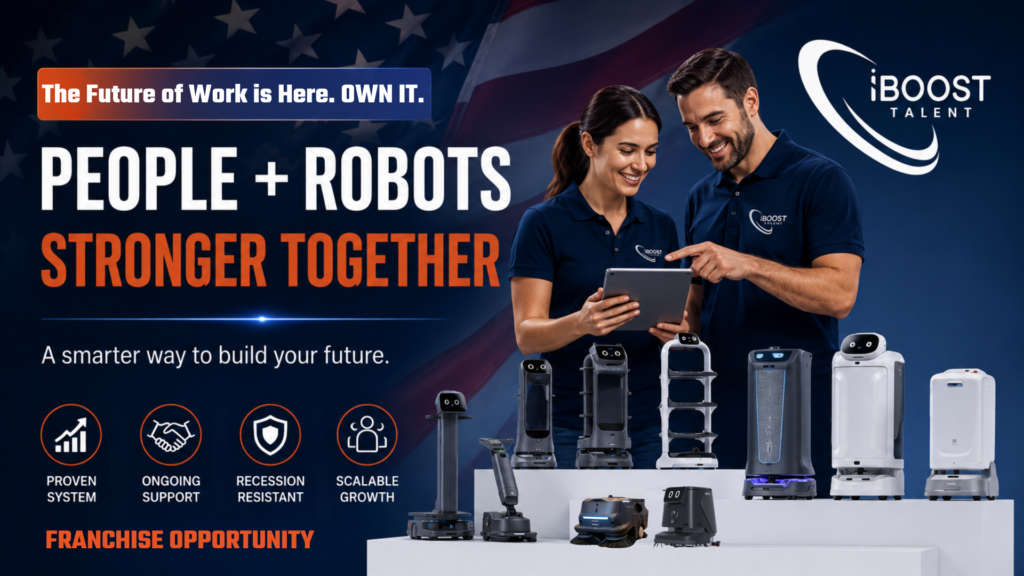
Businesses increasingly need people, workforce strategy, and automation working together.
Through our connected family of companies, iBoost Talent owners can bring clients more than traditional staffing and recruiting. They are backed by more than 25 years of workforce expertise through Impact Workforce Solutions and the ability to augment labor with automation through Impact Robotics.
The future of work is not robots or people. It is bringing people, processes, and technology together to improve performance — and quality of life.
The biggest takeaway: Don’t rule yourself out
You may have more options than you realize. Before deciding that business ownership is financially out of reach, learn what funding strategies may be available, evaluate your local market, and speak with professionals who can help you understand the full picture.
As Michele shared at the end of our conversation:
“If you have even a little curiosity about owning a business, talk to somebody about it. Don’t worry about the funding initially. Figure out what you want to do and start your research.”
Ready to explore what staffing business ownership could look like for you? Hop on Bill’s calendar for an honest conversation about your future. Or request a personalized workforce market report.
This article is for educational purposes only and should not be considered financial, tax, or legal advice. Consult qualified professionals before making funding or investment decisions.