
Can You Use Your 401(k) to Start a Staffing Business?
One of the biggest misconceptions about business ownership is that you need a large bank loan or outside investors to get started. For many experienced staffing professionals, funding, not experience, is the biggest obstacle standing between them and ownership.
That’s why more entrepreneurs are learning about Rollover for Business Startups (ROBS), an IRS-recognized funding strategy that may allow qualified individuals to invest eligible retirement savings into a business without taking an early withdrawal or paying early withdrawal penalties.
It’s not the right fit for everyone… but for some future business owners, it’s an option worth understanding.
“There are people sitting on $100K in a 401(k) right now, convinced they can’t afford to start a business. ROBS changes that conversation completely. You already have the capital — you just don’t know it yet.” — Michele Simones, Franchise Funding Specialist with Guidant Financial
What Is a Rollover for Business Startups (ROBS)?
A Rollover for Business Startups (ROBS) is a funding structure that allows qualified entrepreneurs to use eligible retirement funds to capitalize a new or existing business. Unlike withdrawing money from a retirement account, a properly structured ROBS transaction is designed as an investment through a qualified retirement plan rather than a taxable distribution.
Many people consider ROBS because it may allow them to:
- Invest in their own business
- Avoid traditional business loan payments
- Avoid taking on investor equity
- Preserve cash flow during the early stages of ownership
Because ROBS involves IRS and ERISA rules, it must be structured and administered correctly.
How Does ROBS Work?
While every situation is unique, the process generally follows five major steps:
1. Form a C Corporation
ROBS requires the business to operate as a C Corporation because the retirement plan purchases company stock. Other business entities, such as LLCs or S Corporations, aren’t eligible for this structure.
2. Establish a New Retirement Plan
The new corporation creates a qualified retirement plan, typically a 401(k), which becomes the vehicle for the investment.
3. Roll Eligible Retirement Funds
Eligible retirement funds, such as many former employer 401(k)s or traditional IRAs, are rolled into the new company retirement plan through a non-taxable rollover when completed properly.
4. Purchase Company Stock
The retirement plan purchases stock in the new corporation. The business then receives working capital from the stock purchase.
5. Launch and Operate the Business
Once funded, the corporation uses those funds to purchase or launch the business while the owner works in the company full time.
What Happens to the Money in Your 401(k)?
One of the most common questions prospective business owners ask is, “What actually happens to the money in my 401(k)?”
With a Rollover for Business Startups (ROBS), your retirement savings don’t simply disappear or get spent. Instead, your eligible retirement funds become an investment in your new business through your company’s qualified retirement plan.
Rather than being invested in stocks or mutual funds, your retirement plan invests in your own company by purchasing shares of the business. In other words, you’re investing in yourself instead of a company you have no control over.
As your business grows, the value of that investment may grow as well. Like any investment, there is risk, but many entrepreneurs appreciate having the opportunity to directly influence the success of the business they’re investing in.
Another potential advantage is that you’re building your business using your own capital rather than taking on traditional business debt. Without monthly loan payments reducing early cash flow, many business owners have greater flexibility to invest back into growing their company.
When the time comes to transition or sell the business, the value you’ve built belongs to you. Every situation is different, but for many entrepreneurs, ROBS provides a way to invest retirement assets into something they own, lead, and help grow.
Who Might Consider ROBS?
ROBS isn’t designed for every entrepreneur. It may be worth exploring if you:
- Have approximately $50,000 or more in eligible retirement savings
- Want to own and actively operate your business
- Prefer to explore alternatives to traditional business loans
- Understand the importance of maintaining ongoing compliance
If you don’t meet those criteria, there are many other funding options available that may be more appropriate.
Is ROBS Legal?
One of the most common questions prospective business owners ask is whether ROBS is legal. The answer is yes.
ROBS has existed for decades and is based on provisions within ERISA and the Internal Revenue Code that allow qualified retirement plans to invest in Qualified Employer Securities when properly structured and maintained. That said, compliance is critical.
Proper plan administration, annual filings, testing requirements, and documentation are all part of maintaining a compliant ROBS structure over time.
Why Experience Matters
ROBS isn’t simply paperwork. It involves:
- Corporate formation
- Retirement plan administration
- IRS reporting
- Department of Labor compliance
- Annual plan testing
- Ongoing plan maintenance
That’s why many entrepreneurs choose to work with experienced providers who specialize in administering these plans and supporting long-term compliance.
Funding Is Only One Part of Ownership
At iBoost Talent, we believe funding is just one piece of building a successful staffing business.
Whether someone uses traditional financing, SBA lending, personal capital, or explores a Rollover for Business Startups, long-term success depends on having the right systems, coaching, recruiting support, operational guidance, and business development strategy.
Ownership isn’t just about getting started. It’s about building something that lasts.
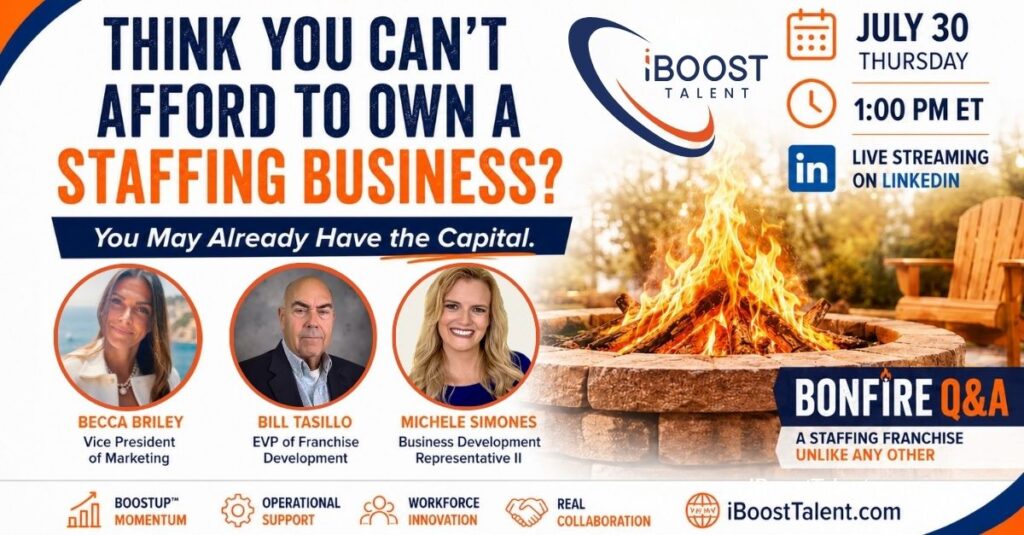
Join Our Upcoming Bonfire Q&A
Want to learn more? Join Becca Briley, Bill Tasillo, and special guest Michele Simones, Franchise Funding Specialist with Guidant Financial, as we discuss:
- What Rollover for Business Startups (ROBS) is
- Who it may be appropriate for
- Common misconceptions
- Questions to ask before choosing a funding strategy
- How prospective staffing owners evaluate funding options
Bring your questions and join us around the bonfire for LIVE Q&A: How to Fund Your Staffing Business Without Taking on Debt – iBoost Talent.
📅 Thursday, July 30 | 🕐 1:00 PM ET | 📍 Live on LinkedIn
Ready to Build Your Staffing Business?
Whether your focus is industrial staffing, logistics, healthcare, skilled trades, construction, manufacturing, professional recruiting life sciences, IT, you name it, let’s look at what stands out in your immediate area. If you’re ready to move from building someone else’s business to building your own, explore available markets and request your custom territory report today.