
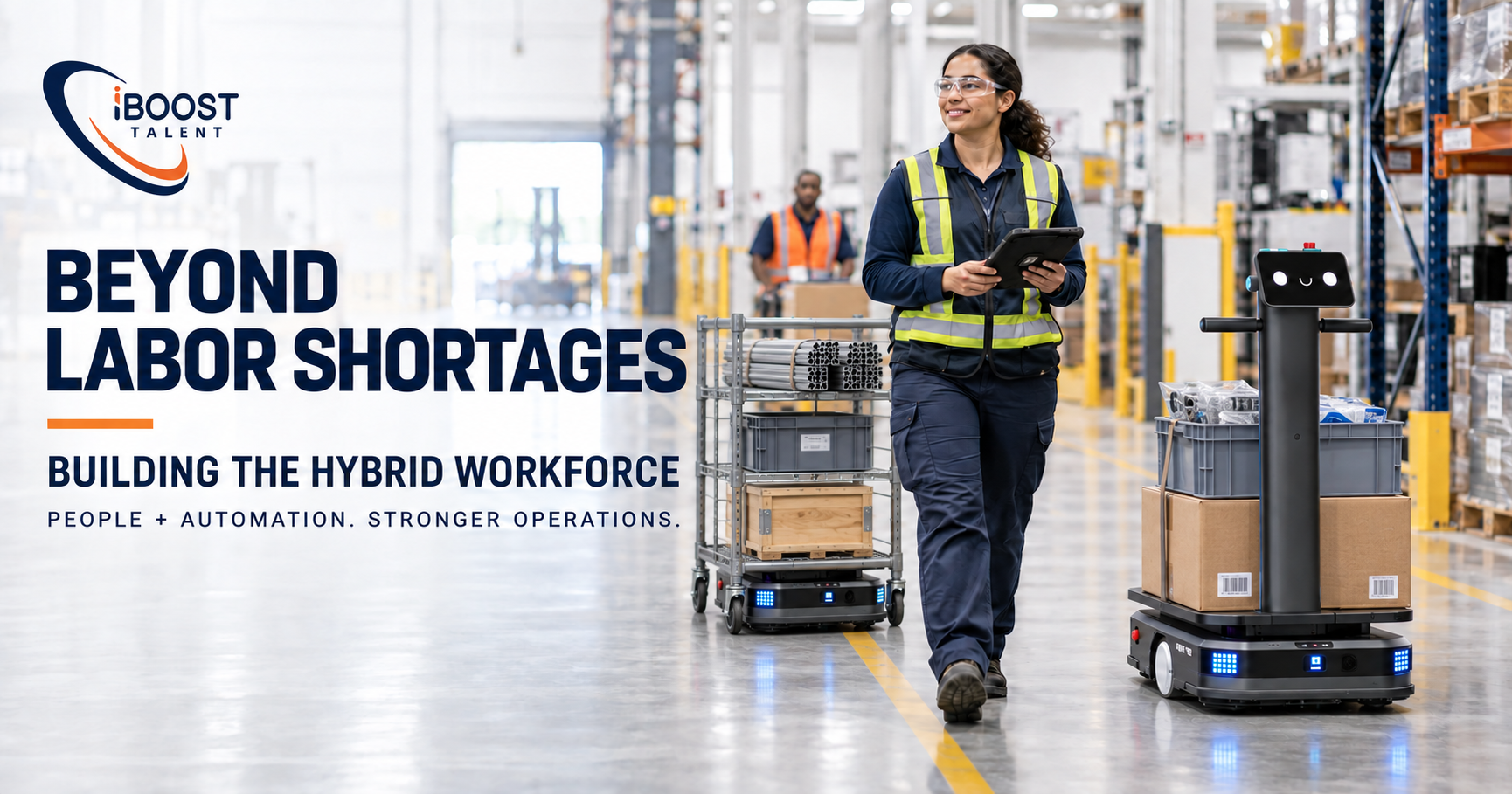
By Bill Tasillo, Executive Vice President of Franchise Development, iBoost Talent
“Robots are not replacing the human workforce; they are repositioning it. Tomorrow’s successful companies will strategically combine skilled people with intelligent, flexible automation to create safer, more productive, and more resilient operations.” — Bill Tasillo
The Workforce Has Changed
The conversation surrounding today’s workforce often begins with a familiar challenge: employers cannot find enough reliable people. But the issue is more complex than a simple labor shortage.
In August 2026, the national unemployment rate remained at 4.1%, with approximately 7 million people unemployed, according to the U.S. Bureau of Labor Statistics. On the surface, those figures suggest a relatively stable labor market. Yet employers across manufacturing, logistics, distribution, healthcare, retail, hospitality, and commercial facilities continue to struggle with recruiting, retention, absenteeism, rising labor costs, and operational consistency.
The disconnect is not necessarily a lack of people. It is often a mismatch between the work available, the compensation employers can sustain, and what workers need from a job.
For many positions, the cost of commuting, childcare, transportation, and other daily necessities can make a job financially impractical. Employers may increase wages and still experience frequent turnover, while workers continue searching for opportunities that offer better pay, flexibility, stability, or advancement.
At the same time, autonomous mobile robots, commercial cleaning robots, automated material-handling systems, and AI-powered workflows are becoming more practical, flexible, and financially accessible.
The question is no longer whether automation will become part of the workforce.
The better question is: How can businesses combine human talent and automation to build a safer, more productive, and more resilient operation?
What Is a Hybrid Workforce?
A hybrid workforce brings people and intelligent automation together within one coordinated workforce strategy. It is not a decision between hiring people or deploying robots. It is the intentional assignment of work based on the strengths of each resource.
People excel when work requires:
- Judgment and critical thinking
- Adaptability
- Customer interaction
- Creativity
- Problem-solving
- Leadership
- Complex decision-making
Automation is particularly effective when work is:
- Repetitive
- Predictable
- Physically demanding
- Time-consuming
- Difficult to staff consistently
- Vulnerable to turnover or absenteeism
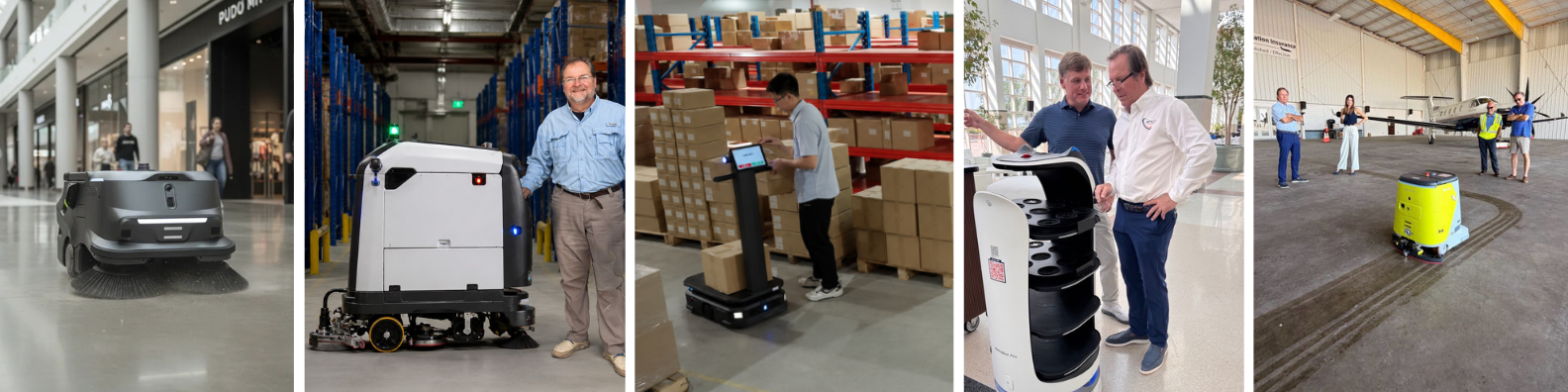
Common applications include:
- Floor sweeping, scrubbing, and vacuuming
- Facility cleaning
- Material and tool transportation
- Small-item and product delivery
- Inventory movement
- Routine inspection and monitoring
- Repetitive warehouse transportation
Automation can perform these necessary tasks consistently, allowing people to focus on the work that depends on human insight, relationships, and decision-making.
From Repetitive Tasks to Higher-Value Work
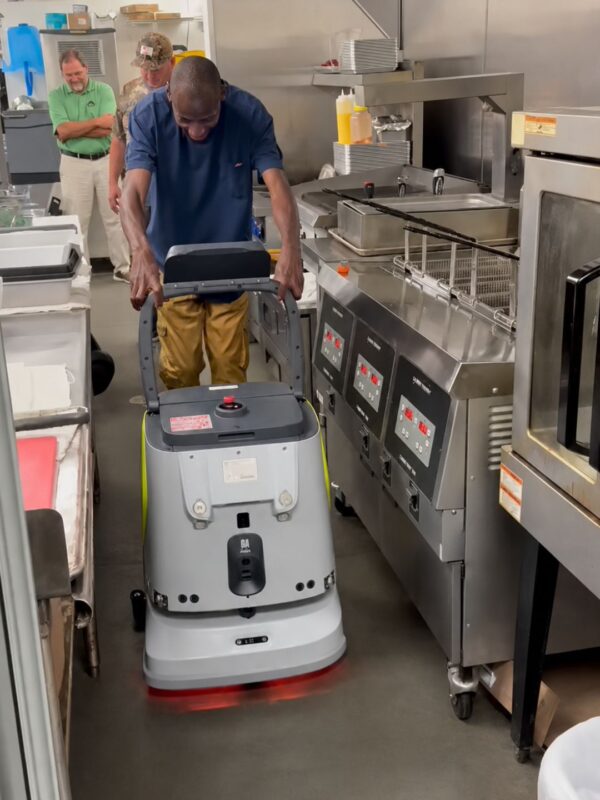
When a skilled employee spends hours pushing a tool cart, walking materials across a facility, or operating a floor-cleaning machine, the organization may not be using that person’s capabilities effectively.
Automation creates an opportunity to redesign the work.
An employee who previously spent most of a shift on repetitive transportation or cleaning tasks may be trained for a customer-facing, technical, supervisory, quality-control, or revenue-generating role. The organization gains greater value from that employee, while the employee gains the opportunity to develop more valuable skills.
This is where the conversation around automation must change.
The goal should not simply be to remove labor from an operation. The goal should be to remove low-value, repetitive, and physically demanding tasks from people’s workloads.
The Business Benefits of a Hybrid Workforce
A thoughtfully designed human-and-robot workforce can produce benefits across the organization.
Greater Productivity
Robots can consistently perform routine tasks while employees concentrate on work requiring flexibility, communication, and problem-solving. Both resources are used where they can create the greatest return.
Improved Workforce Stability
Automation can provide dependable operational support when employers face hiring challenges, turnover, absenteeism, or seasonal demand. It creates a predictable layer of capacity within the workforce.
Safer Working Environments
Repetitive lifting, long walking routes, strenuous cleaning, and material movement can contribute to fatigue and workplace injuries. Automating portions of this work can reduce physical strain and allow employees to focus on safer, more valuable activities.
More Predictable Operating Costs
Human labor includes variables such as overtime, vacancies, benefits, workers’ compensation, training, and turnover. Automation provides a more predictable level of capacity at a defined cost, making workforce planning and budgeting easier.
Scalable Operations
Businesses can combine flexible labor resources with consistent automation capacity as demand changes. This creates a workforce model that can adapt without relying exclusively on additional headcount.
The Barriers to Automation Are Changing
Historically, robotics required a substantial capital investment, extensive facility modifications, and specialized technical resources. That made automation practical primarily for large, high-volume organizations.
That is no longer always the case.
Robotics-as-a-Service, leasing, financing, and managed automation programs can convert a major capital expense into a predictable operating cost. In some models, deployment, training, maintenance, and ongoing support can be included in a recurring payment structured similarly to a weekly labor expense.
This gives more small and midsized organizations access to automation without requiring them to build an internal robotics department. However, affordability is only one part of successful implementation.
Technology Alone Does Not Create Transformation
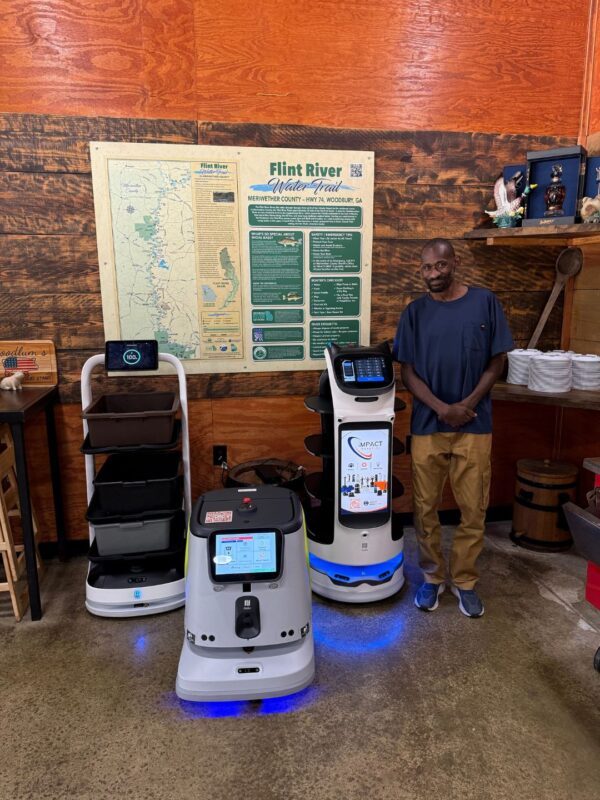
Robots are most effective in structured and reasonably predictable environments. Unexpected conditions may still require human intervention. Businesses must also prepare employees to supervise, maintain, and optimize automated systems.
The greatest obstacle may be employee perception.
If automation is introduced without clear communication, employees may view it as a direct threat to their job security. That uncertainty can create resistance before the technology is ever deployed.
Leadership must explain:
- Which tasks the technology will perform
- Why those tasks were selected
- How employees’ roles may change
- What training and advancement opportunities will be available
- How automation can improve safety and reduce physical strain
- Why people will remain essential to the operation
Organizations should identify employees who can grow into robot supervision, fleet management, technical support, quality assurance, and other newly created responsibilities.
When people understand how automation can support them, adoption becomes significantly easier.
Start with the Work, Not the Robot
 The strongest automation strategies do not begin by selecting a robot. They begin by understanding the operation. Leaders should evaluate:
- Which tasks are repetitive, predictable, or physically demanding?
- Where are turnover and absenteeism creating the greatest disruption?
- Which responsibilities prevent employees from performing higher-value work?
- What does the task currently cost in labor, overtime, injuries, downtime, and lost productivity?
- How would employees be repositioned if the task were automated?
- What outcome would define a successful deployment?
A pilot program can then test the technology in a real operating environment before the organization scales it across additional locations or workflows.
This approach makes automation a workforce decision—not simply a technology purchase.
A New Opportunity for Staffing and Workforce Leaders
Staffing companies have traditionally helped employers solve workforce challenges by supplying people. That role is evolving.
The next generation of workforce providers must be able to examine the entire operation and recommend the right combination of talent, automation, and managed workforce solutions.
Sometimes the right answer will be additional employees. Sometimes it will be automation. Increasingly, it will be both.
This shift allows workforce professionals to move beyond filling positions and become strategic advisors focused on productivity, workforce design, and business outcomes.
The Future Is People and Robots Working Together
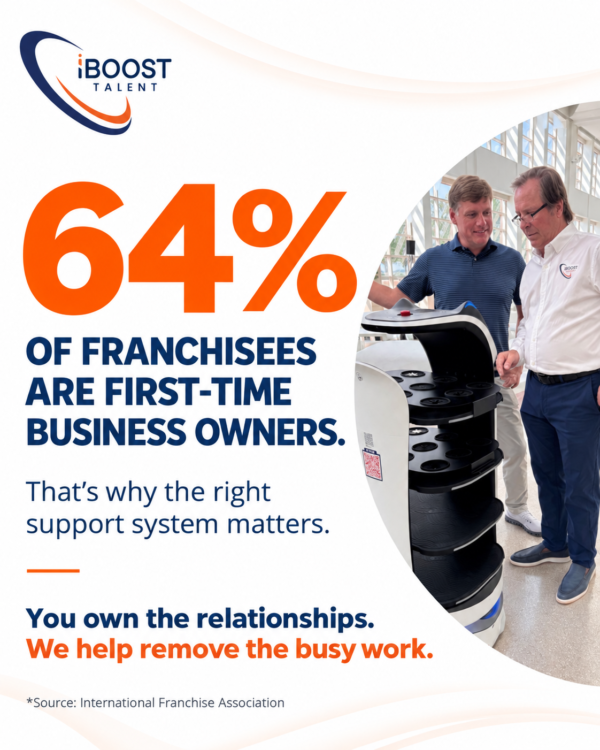 Long-term success will not come from choosing between people and automation. It will come from building hybrid workforces in which technology augments human capability.
As automation handles routine, repetitive, and physically demanding tasks, people can focus on creativity, service, critical thinking, leadership, and operational excellence.
The future of work is not humans versus robots. It is humans and robots working together to accomplish outcomes neither could achieve as effectively alone.
Automation is not replacing the workforce. It is reshaping it. The winning organizations will strategically combine skilled people with intelligent automation to create safer, more productive, and more resilient operations. — Don G. King, Founder
About iBoost Talent
iBoost Talent is building the next generation of workforce solutions by bringing together talent, robotics, and managed workforce expertise. Through the support of Impact Workforce Solutions and Impact Robotics, iBoost Talent Owner/Operators can help businesses solve workforce challenges with solutions designed around productivity — not simply headcount.